

Vinyl vs. Fiberglass Windows: A Victoria Homeowner’s 2026 Buying Guide
If your windows are weeping with condensation every time a Pacific storm rolls off the Juan de Fuca Strait, you aren’t just losing heat; you’re losing the battle against Victoria’s relentless coastal moisture. It’s a common frustration for many of us here. You want a home that feels like a sanctuary, not a drafty corridor. When you’re weighing the choice of vinyl vs fiberglass windows Victoria BC homeowners often find themselves caught between managing upfront costs and ensuring long-term durability.
We believe your home should be a place of permanence and pride. Choosing the right materials is about more than just aesthetics; it’s about structural integrity and your daily comfort. This guide helps you discover which window material best withstands our salt-air environment while maximizing your property’s resale value and energy efficiency. We’ll break down the 2026 BC Building Code requirements and the current status of CleanBC rebates, providing you with a clear path toward a maintenance-free home. Mitchell personally manages the entire process through an owner-led design-build model, ensuring your project receives the dedicated oversight and accountability it requires.
Key Takeaways
- Learn why Victoria’s unique coastal humidity and salt air require specific window seal standards to prevent premature frame failure.
- Understand the performance gap of vinyl vs fiberglass windows Victoria BC to determine which material offers the best thermal stability for your home’s specific architecture.
- Navigate the 2026 BC Building Code requirements and learn how high-performance U-values impact your eligibility for current provincial efficiency rebates.
- Discover how a strategic window investment can recoup up to 70% of its value while significantly reducing your monthly heating and cooling costs.
- Realize the benefit of a single point of accountability through Mitchell’s owner-led management of every installation detail and vetted subcontractor.
Navigating Window Replacement in Victoria’s Coastal Climate
Victoria homeowners face a unique challenge that many national brands don’t address. Our city is a collection of micro-climates. A home in James Bay deals with wind-driven rain and heavy salt spray. A residence in Langford experiences higher temperature swings and intense summer heat. When debating vinyl vs fiberglass windows Victoria BC residents must look beyond basic aesthetics. The constant humidity and saline environment demand higher standards for frame seals and hardware finishes. Salt air is aggressive. It can pit and corrode standard hardware in just a few seasons, leading to windows that stick or fail to lock properly.
Choosing between a simple insert replacement and a full-frame renovation is a critical first step. An insert might save money today. It doesn’t address potential rot in the rough opening or the integrity of the building envelope. We believe in the enduring value of doing things right the first time. This means ensuring your new windows integrate perfectly with your home’s existing moisture barrier. Mitchell personally guides this entire process with a single point of accountability. He ensures that every exterior window and door project meets our standards for craftsmanship by managing the installation through his vetted subcontractors.
The Reality of Salt Air and Humidity
Living with coastal exposure in neighbourhoods like Oak Bay or Fairfield means your frames are constantly bathed in a fine mist of salt. This isn’t just a cleaning nuisance. It’s a chemical challenge for your window’s moving parts. We emphasize the use of high-grade, stainless steel or coated hardware. Standard components often fail prematurely in our damp environment. Managing condensation is another local hurdle. By utilizing advanced Insulated glazing technology, you can significantly reduce the internal glass temperature drops. This prevents the mold-inducing moisture buildup that often plagues Pacific Northwest sills.
Victoria’s 2026 Building Standards
As of 2026, the BC Building Code has raised the bar for thermal performance. To qualify for current CleanBC rebates, windows must now meet a U-factor of 1.22 W/m²-K or less. These standards aren’t just bureaucratic hurdles. They’re designed to help Victoria reach its long-term energy goals and reduce the strain on our local grid. Simply looking for an Energy Star sticker isn’t enough anymore. You need a solution that balances glass coatings with frame insulation. This is why the design and planning phase is so vital. Mitchell personally oversees this selection process. He ensures the specifications match both the code requirements and the specific exposure levels of your property.
Comparing Material Performance: Vinyl vs. Fiberglass
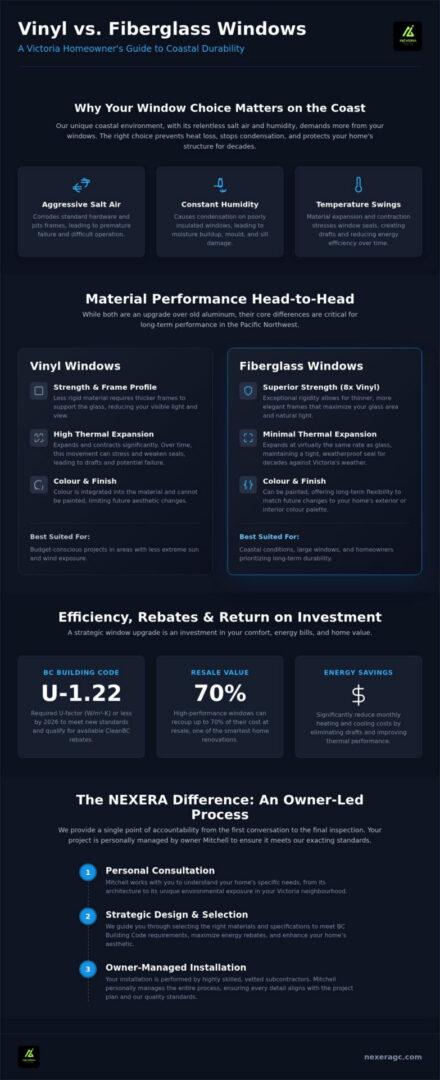
Choosing between vinyl vs fiberglass windows Victoria BC requires looking past the surface. While both materials offer a massive leap in comfort compared to the old aluminum frames found in many Fairfield or Gordon Head homes, their structural DNA is quite different. The primary distinction lies in how these materials respond to the physical stresses of the Pacific Northwest. Fiberglass is approximately eight times stronger than vinyl by cross-section. This inherent rigidity allows for much thinner frame profiles, which means you get more glass and a wider view of the Olympic Mountains or your private garden.
Thermal expansion is where the performance gap becomes most apparent. Vinyl frames tend to expand and contract significantly as temperatures fluctuate. This movement can eventually stress the seals between the frame and the glass. Fiberglass is composed primarily of glass fibres and resin, meaning it expands at nearly the same rate as the glass panes it holds. This harmony keeps the unit tighter over decades of Victoria winters. Technical reports like the Window Performance and Selection Guidelines emphasize that material stability is a cornerstone of long-term seal integrity and energy performance.
Maintenance for both is remarkably low. You won’t be scraping or painting these every few years to prevent rot. A simple seasonal rinse to remove salt spray and dust is usually all that is required to keep the hardware moving smoothly and the frames looking fresh. If you are unsure which material fits your home’s specific exposure, you can always reach out to Mitchell for a professional perspective on your project.
Vinyl: The Practical Choice
Modern vinyl windows utilize advanced uPVC technology. This material is specifically engineered to resist the yellowing and cracking that plagued older plastics. It’s an excellent, cost-effective solution for multi-room home renovations or finishing a basement suite. uPVC is a low-conductivity material ideal for insulation because it naturally resists the transfer of heat through the frame. While the profiles are slightly thicker than fiberglass, the multi-chambered designs provide exceptional thermal pockets that keep your heating bills manageable.
Fiberglass: The Premium Performer
Fiberglass is the gold standard for durability, especially in high-wind areas like the Saanich Peninsula. Its strength allows it to support heavy, triple-pane glass in large spans without bowing or sagging. For homeowners in heritage-rich areas like Rockland, fiberglass offers a unique aesthetic advantage. Unlike vinyl, which usually has a permanent finish, fiberglass can be painted. This allows you to match specific historical colour palettes while enjoying 21st-century efficiency. Mitchell ensures these high-performance units are installed with precision, managing every detail through his vetted subcontractors to maintain a single point of accountability.
Energy Efficiency and ROI: Which Investment Pays Off?
Investing in new windows is one of the most impactful decisions you can make for your home’s long-term value. In Victoria’s competitive real estate market, buyers look closely at the building envelope. They want to know that a home won’t just look beautiful, but will also be efficient to run. When analyzing vinyl vs fiberglass windows Victoria BC homeowners should focus on the U-value. This measurement tracks how much heat escapes through the window; a lower number indicates better insulation. Current 2026 standards require a U-factor of 1.22 W/m²-K or less to meet efficiency benchmarks. While both materials can achieve this, fiberglass often reaches even higher performance levels, providing a tighter barrier against the damp Island air.
The return on investment for high-quality windows is remarkably stable. Industry data suggests that both vinyl and fiberglass replacements typically see a resale value return of 60% to 70% of the initial cost. Beyond the eventual sale, the immediate impact on your BC Hydro bill is where you’ll feel the difference. Modern exterior windows and doors eliminate the drafts that force your heating system to work overtime in the winter and keep your home cooler during our increasingly warm summers. A recent This Old House homeowner survey highlights that while initial costs vary, the durability and thermal performance of fiberglass often lead to higher satisfaction over the life of the home.
Calculating Long-Term Value
Cheaper isn’t always better when you consider the life-cycle of the product. Vinyl windows generally offer a lifespan of 20 to 30 years. Fiberglass, however, can last 30 to 50 years due to its extreme durability and resistance to thermal expansion. If you are aiming for higher Step Code compliance or a “Net Zero Ready” home, fiberglass provides the structural strength needed for the heavy triple-pane glass required for those standards. Mitchell personally oversees the selection process to ensure the product you choose aligns with your financial goals and your home’s longevity.
Navigating BC Rebates and Permits
Taking advantage of provincial incentives can significantly offset your project costs. The CleanBC Home Efficiency Rebate currently offers $100 per window, up to a total of $2,000, provided the units meet the 1.22 U-factor requirement. Securing these rebates requires meticulous documentation and professional installation. Furthermore, obtaining municipal permits in Victoria, Saanich, or Langford is a vital step that many homeowners overlook. These permits ensure your renovation meets safety standards and protects your home’s legal status. Mitchell manages these administrative details through his single-point-of-accountability model, using vetted subcontractors to ensure every technical requirement is satisfied for a successful rebate application.
Strategic Selection: Choosing for Your Specific Victoria Home
Selecting the right window requires a strategic look at how your home interacts with our local environment. It isn’t just a matter of vinyl vs fiberglass windows Victoria BC; it’s about identifying which elevations of your property face the brunt of our winter storms. If you’re living in a high-exposure area like Ten Mile Point or along the Dallas Road waterfront, your southwest-facing windows endure relentless wind and rain. In these cases, the structural rigidity of fiberglass provides a more secure barrier against the elements. Conversely, for protected sides of the home or lower levels, vinyl offers a reliable and cost-efficient solution without compromising on thermal performance.
For those situated near busy corridors like Douglas Street or the Hillside area, sound dampening becomes a top priority. High-performance frames paired with thick, multi-pane glass significantly reduce the intrusion of urban noise. While both materials perform well, the density of fiberglass often provides a slight edge in creating a quiet interior sanctuary. We often suggest a phased approach if a whole-home replacement doesn’t fit your immediate budget. Prioritizing the most weather-beaten windows first ensures you protect your home’s envelope where it’s most vulnerable. This methodical planning allows you to invest in higher-quality materials where they matter most while utilizing vinyl to manage costs elsewhere.
Matching Material to Home Style
Every neighbourhood in Victoria has its own architectural rhythm. In heritage-rich areas like Rockland or Fernwood, fiberglass frames are often the preferred choice. Their slim profiles and paintable surfaces allow us to respect the original character of a historic home while providing modern protection. Vinyl remains a fantastic option for modern condo renovations or finishing a basement suite, offering a clean, contemporary look. If you’re unsure how to balance these choices, our design and planning service helps you visualize the best layout for your specific property.
The Installation Factor
A premium window is only as effective as the person installing it. In the Pacific Northwest, the moisture barrier and flashing are the most critical components of the project. If these aren’t handled with meticulous care, even the most expensive fiberglass unit will eventually lead to rot and leaks. Mitchell personally oversees every installation, ensuring that the transition between your new windows and existing siding is seamless and watertight. By managing vetted subcontractors directly, he maintains total accountability for the craftsmanship and long-term performance of your home’s exterior.
The Nexera Difference: Owner-Led Window Replacement
Choosing to upgrade your home is a decision rooted in long-term vision. NEXERA Home Renovations operates as an owner-led design-build firm, meaning Mitchell Lucas and his partner are directly involved in the success of your project. We don’t employ an in-house crew; instead, Mitchell manages a network of vetted local subcontractors who are specialists in window systems. This structure provides you with a single point of accountability. You’ll never have to navigate the bureaucracy of a large corporation or deal with a rotating list of project managers. From the first measurement to the final seal, the owners of the company are responsible for the quality and integrity of the work.
Our commitment to your home is solidified by a 2-year workmanship warranty. This isn’t just a document; it’s a reflection of our confidence in the craftsmanship of the professionals we manage. When you’re making the final call on vinyl vs fiberglass windows Victoria BC homeowners need to know that the installation will withstand our wet, coastal winters. We take the time to ensure every flashing detail and moisture barrier is perfect, protecting your investment for decades to come. We view our work as an enduring contribution to the community, focusing on the artistry and the human element of the construction process.
A Personalized Design-Build Approach
We believe that a window replacement should be part of a broader conversation about your home’s performance. NEXERA Home Renovations integrates exterior windows and doors into a comprehensive design and planning process. This ensures that your new windows work in harmony with your home’s architectural style and future renovation goals. By maintaining honest and transparent communication, we build a partnership based on trust and shared standards of excellence. This methodical approach reflects the careful planning required to ensure your home remains a sanctuary for years to come.
Your Next Step for a More Efficient Home
Navigating the technical specifications of modern window systems can be overwhelming. A professional consultation allows us to assess your home’s specific needs, whether you’re dealing with wind-driven rain in Oak Bay or city noise near Douglas Street. Mitchell provides the clarity you need to choose the right materials and maximize your energy rebates. We’re here to provide the steady, reliable hand that guides your renovation from conception to a successful completion. Every project is an opportunity to create something meaningful, and we treat your home with the personal attention it deserves.
Preserving Your Home’s Legacy Through Quality
Selecting new windows is a meaningful step in preserving your home’s legacy. We’ve explored how Victoria’s coastal moisture and the 2026 BC Building Code standards guide the choice of vinyl vs fiberglass windows Victoria BC. Whether you choose the premium durability of fiberglass or the practical efficiency of modern vinyl, the success of your project depends on meticulous planning and professional installation. Our owner-led design-build model ensures every detail is managed with total accountability; from selecting corrosion-resistant hardware to ensuring a watertight seal against the Pacific wind.
Mitchell personally oversees every project, working with vetted local subcontractors to deliver craftsmanship that stands the test of time. With our 2-year workmanship warranty, you’ll feel confident your home is protected long after the final walkthrough. We’re dedicated to helping you create a sanctuary that’s energy-efficient, quiet, and enduring.
Take the first step toward a more comfortable and valuable home today. We look forward to helping you realize your vision with honesty and local expertise.
Frequently Asked Questions
Are fiberglass windows really worth the extra cost in Victoria?
Yes, fiberglass often provides a better long-term return for homes in high-exposure areas. While the upfront investment is higher than vinyl, fiberglass is eight times stronger and has a lifespan of 30 to 50 years. It handles our coastal temperature swings without warping, which protects the integrity of your window seals for decades. This durability makes it a premier choice for those looking to maximize their home’s resale value and energy performance.
Do I need a permit to replace windows in Saanich or Langford?
Yes, most municipalities in Greater Victoria require a building permit for window replacements to ensure compliance with the BC Building Code. These permits verify that new units meet specific safety and energy efficiency standards, such as proper egress for bedrooms. Mitchell manages this entire administrative process through our owner-led design-build model. This ensures your project is fully documented and legally compliant, which is vital for future property transactions.
Can vinyl windows withstand the salt air if I live near the ocean?
Modern uPVC vinyl windows are remarkably resilient in coastal environments. They won’t rot, rust, or peel when exposed to the salty mist common in James Bay or Oak Bay. The frame material itself is immune to salt corrosion; however, the hardware is often the weak point. We ensure your windows are equipped with high-grade, corrosion-resistant hardware to keep the moving parts functional and smooth despite the aggressive sea air.
How long does a typical window replacement project take in Victoria?
The installation phase for most residential projects typically takes between two to five days. This timeline depends on the number of windows and whether you are opting for a retrofit or a full-frame replacement. While the physical work is efficient, remember that custom windows have a manufacturing lead time that can span several weeks. Mitchell coordinates closely with vetted subcontractors to ensure the on-site work is completed with minimal disruption to your daily life.
Is it better to replace all windows at once or can I do it in stages?
Replacing all windows at once is more cost-effective due to reduced mobilization fees, but a phased approach is a practical way to manage a budget. If you choose to stage the project, we recommend prioritizing the elevations that face the prevailing winds and rain first. This protects your home’s envelope where it’s most vulnerable. We can help you develop a long-term plan that ensures a consistent look across your home as you upgrade.
Which window material provides the best soundproofing against city noise?
Fiberglass frames paired with triple-pane glass offer the most effective barrier against urban noise. The inherent density of fiberglass helps dampen sound vibrations better than lighter materials. When comparing vinyl vs fiberglass windows Victoria BC homeowners near busy routes like Douglas Street often choose fiberglass for its structural strength. This rigidity allows the frame to support the heavy, sound-dampening glass units required to create a quiet interior sanctuary.
What should I look for in a window warranty in British Columbia?
You should prioritize a warranty that covers both the product and the installation. Most manufacturers provide 10 to 20 years on the frames and glass, but these don’t cover leaks caused by poor fitting. This is why we provide a 2-year workmanship warranty on every project Mitchell manages. It gives you peace of mind that the installation, performed by our vetted subcontractors, is held to the highest professional standards of the design-build industry.
How do I know if I need a full-frame replacement or just a retrofit?
A full-frame replacement is necessary if there is any evidence of rot or moisture damage in the existing window opening. A retrofit, or “insert” window, simply fits into the old frame; this is faster but can hide underlying structural issues. If your home has been exposed to years of wind-driven rain, Mitchell will assess the rough opening to ensure the building envelope is secure. Doing it right the first time prevents costly repairs to your home’s structure later on.